
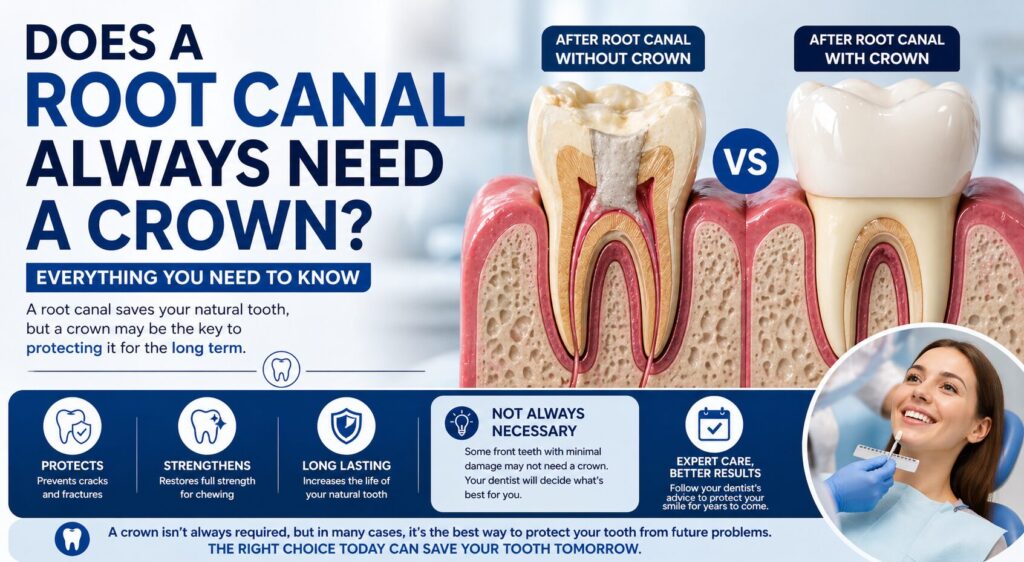
Does a Root Canal Always Need a Crown?
If you’ve had or are planning a root canal, it’s normal to wonder if a dental crown is always required afterward. The honest answer is no, not always. But in many cases, especially for long-term strength and protection, a crown is strongly recommended.
What Happens to a Tooth After a Root Canal
A root canal removes infected pulp from inside the tooth and seals it. While this saves the tooth, it also changes its structure.
After treatment, the tooth often becomes:
- More brittle due to loss of internal tissue
- More prone to cracking under pressure
- Less resistant to everyday chewing forces
Because of this, restoring the tooth properly is essential.
When You Do Not Need a Crown
In some situations, a crown may not be necessary.
Front Teeth (Incisors and Canines)
Front teeth do less heavy chewing. If the tooth structure is mostly intact, a filling may be enough.
Minimal Damage
If the tooth had little decay and remains strong after the root canal, your dentist might recommend a direct filling instead of a crown.
Temporary or Monitoring Cases
Sometimes dentists delay crown placement to monitor healing or due to patient-specific factors.
When a Crown Is Recommended
In many cases, placing a crown is the safest long-term option.
Back Teeth (Molars and Premolars)
These teeth handle most of the chewing force. Without a crown, they have a higher risk of fracture.
Large Fillings or Structural Loss
If a significant portion of the tooth is missing, a crown helps restore strength and function.
Cracked or Weak Teeth
Teeth that already show signs of cracks or weakness need full coverage protection.
Risks of Not Getting a Crown After Root Canal
Skipping a crown when it is needed can lead to:
- Tooth fracture
- Loss of the treated tooth
- Need for extraction or implant later
- Additional dental costs
This is why many dentists recommend crowns as a preventive step rather than waiting for damage.
What Are the Alternatives to a Crown
Depending on the case, your dentist may suggest:
- Composite filling
- Onlay or inlay
- Temporary restoration
However, these options may not provide the same level of protection as a full crown in high-pressure areas.
How Dentists Decide What You Need
Dentists consider several factors before recommending a crown:
- Location of the tooth
- Amount of remaining tooth structure
- Bite force and chewing habits
- Risk of fracture
There is no one-size-fits-all answer. The decision is based on protecting the tooth for the long term.
Conclusion
A root canal does not always require a crown, but in many cases, it is the best way to protect the tooth from breaking. Back teeth and heavily damaged teeth almost always benefit from crowns, while some front teeth may not need one.
The best approach is to follow your dentist’s recommendation based on your specific situation to avoid future complications.