
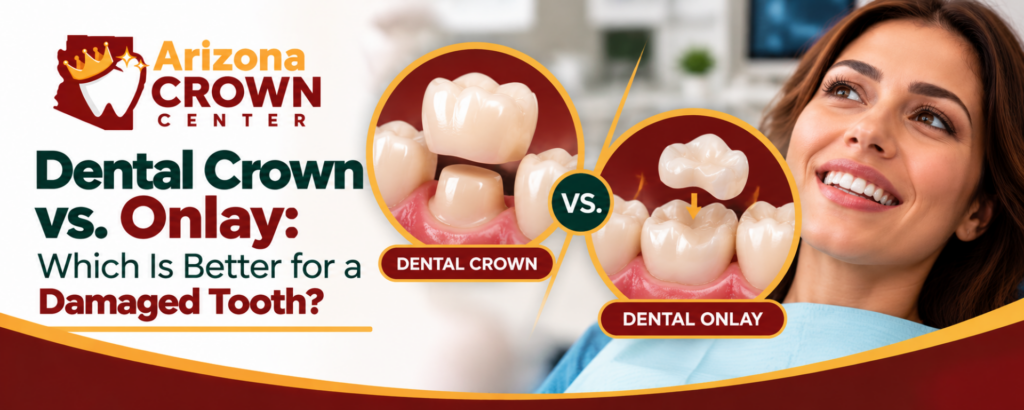
Dental Crown vs. Onlay: Which Is Better for a Damaged Tooth?
When a tooth is damaged, a regular filling may not always provide enough support. Your dentist may discuss a dental crown or an onlay, two restorations that can rebuild a tooth but cover it in different ways. The right choice is not simply the one that sounds stronger or costs less. It depends on how much healthy tooth remains, where the damage is, how your teeth come together, and whether the restoration can be kept clean and stable.
The key difference is coverage: a crown covers the visible portion of a prepared tooth, while an onlay restores a damaged area and covers one or more cusps when needed. An onlay may preserve more natural tooth structure in suitable cases, but it is not right for every tooth. A dental examination is needed to determine which option can reliably restore your bite.
What Is the Difference Between a Dental Crown and an Onlay?
What Is a Dental Crown?
A dental crown is a custom-made restoration that covers the visible part of a tooth above the gumline. It may be recommended when a tooth is significantly weakened, cracked, heavily filled, or needs more coverage than a filling can provide. A crown restores the tooth’s shape and chewing function while helping protect the remaining structure.
Crown materials vary, and the suitable choice depends on the tooth’s location, the bite, appearance goals, and the dentist’s assessment. You can learn more about the treatment on AZ Crown Center’s [dental crown services page](https://www.azcrowncenter.com/cosmetic-crowns/).
What Is a Dental Onlay?
An onlay is a custom restoration that replaces damaged tooth structure and covers one or more cusps, which are the raised points on a tooth’s chewing surface. Unlike a full crown, an onlay does not cover the entire visible tooth. When the tooth has enough healthy structure to support it, an onlay may restore strength while preserving more of the natural tooth.
Onlays are sometimes called partial-coverage restorations. They are not the same as a small filling, and they are not suitable for every type of damage. The decision depends on the tooth’s condition and whether the restoration can be bonded and supported predictably.
Crown vs. Onlay: Key Differences
A crown covers the full visible tooth structure after preparation. An onlay covers a smaller area and extends over the cusps that need protection. This means an onlay may require less removal of healthy tooth structure in appropriate cases, while a crown may be more suitable when the tooth needs more extensive coverage.
Neither option is automatically better in every situation. The important question is whether the restoration can protect the remaining tooth, withstand the forces of chewing, fit correctly, and remain maintainable over time.
When Is a Dental Crown the Better Option?
When a Tooth Has Extensive Damage
If a large part of the tooth is missing or weakened, a crown may be recommended to cover and protect the remaining structure. The amount and location of the damage matter more than the size of the cavity alone. Your dentist may examine the tooth and use dental X-rays when indicated to understand what is happening below the surface.
When a Tooth Has a Large Existing Filling
A tooth with a large filling may have less natural structure left to withstand everyday biting forces. Depending on the remaining walls and cusps, a dentist may recommend a crown or a partial-coverage restoration. A large filling by itself does not automatically mean a crown is required.
When Additional Protection Is Needed After Root Canal Treatment
Some teeth need cuspal coverage after root canal treatment, particularly when significant tooth structure has been lost. A crown may be appropriate, but an onlay or another bonded restoration can be considered in selected cases. The decision should account for the tooth’s location, remaining structure, cracks, and bite forces.
When the Remaining Tooth Cannot Reliably Support an Onlay
An onlay needs a suitable foundation and enough sound tooth structure for predictable retention and support. If the damage is too extensive or the tooth has features that make partial coverage unsuitable, a crown may be the more appropriate option. Your dentist should explain what makes one design more reliable for your particular tooth.
When Might a Dental Onlay Be a Better Option?
When Damage Is Limited to Part of the Tooth
If the damage is confined to a portion of the tooth and enough healthy structure remains, an onlay may be considered instead of covering the entire tooth. This can be useful when a filling would not provide enough support but a full crown may remove more structure than is necessary.
When One or More Cusps Need Protection
The cusps are the raised areas that help teeth grind food. If one or more cusps are weakened or damaged, an onlay can cover those areas while leaving other parts of the tooth uncovered. Whether this is suitable depends on the extent of the damage and the forces placed on the tooth during chewing.
When Preserving Healthy Tooth Structure Matters
Preserving natural tooth structure is an important consideration in restorative dentistry. If a partial-coverage restoration can provide adequate support and a durable seal, an onlay may be a conservative option. However, preserving more tooth structure is only beneficial if the chosen restoration can also function reliably.
When a Filling May Not Provide Enough Support
A filling repairs a cavity or a smaller area of lost tooth structure. When the damage extends into a cusp or leaves the tooth at risk of fracture, a dentist may discuss an onlay or crown. The goal is to choose a restoration that matches the actual damage, not to select the most extensive procedure by default.
Dental Crown vs. Onlay: Benefits and Limitations
Benefits and Limitations of Dental Crowns
A crown provides full coverage of the prepared tooth and may be suitable when a tooth is extensively weakened. It can restore the shape and function of the tooth and protect the remaining structure. The trade-off is that crown preparation generally involves reshaping the tooth to accommodate full coverage. Once tooth structure is removed, it does not grow back.
Benefits and Limitations of Dental Onlays
An onlay can preserve more of the healthy tooth when the case is suitable and can cover weakened cusps. It may be a useful middle option between a filling and a full crown. However, an onlay depends on appropriate case selection, preparation, material, bonding, and bite conditions. It is not always possible or advisable.
Does One Option Always Last Longer Than the Other?
No single lifespan applies to every crown or onlay. Longevity depends on factors such as the tooth’s starting condition, restoration material, bite forces, oral hygiene, fit, and regular dental care. Research comparing partial-coverage restorations with full crowns does not justify a universal promise that one will always last longer. Ask your dentist what outcomes are realistic for your specific tooth.
For more information about care and the factors that influence restoration longevity, read AZ Crown Center’s guide to [how long a dental crown lasts](https://www.azcrowncenter.com/dental-crown-lifespan/).
Is a Dental Crown or Onlay More Expensive?
The cost depends on the restoration, material, tooth condition, laboratory or digital workflow, and whether additional treatment is needed. A crown and an onlay are different procedures, so their prices should not be compared without understanding what each treatment includes.
What Affects the Cost of a Dental Crown?
The price may depend on the crown material, the amount of preparation needed, the complexity of the case, and whether the tooth requires treatment before the crown is placed. If you have dental insurance, ask your insurer and dental office to confirm your benefits, exclusions, and estimated out-of-pocket cost.
What Affects the Cost of a Dental Onlay?
Onlay pricing can vary with the material, design, number of surfaces being restored, and complexity of the tooth. Coverage by dental insurance also varies by plan. Request a written treatment estimate and ask whether the recommended restoration is covered under your specific policy.
Questions to Ask About Your Treatment Estimate
- Why is this restoration recommended for my tooth?
- Could an onlay or another conservative option work in my case?
- What are the benefits and limitations of each option for my tooth?
- Does the estimate include examination, imaging, temporary restoration, and follow-up visits where applicable?
- What portion may be covered by my dental insurance?
What Happens During Crown or Onlay Treatment?
Dental Examination and Tooth Assessment
The dentist examines the tooth, gums, bite, and existing restorations. Dental X-rays or other diagnostic steps may be used when clinically appropriate. The aim is to understand the extent of damage and whether the tooth can be restored predictably.
Preparing the Tooth and Taking Impressions or Digital Scans
If a crown or onlay is chosen, the dentist prepares the affected area to make room for the restoration and create a suitable fit. An impression or digital scan records the tooth’s shape so the restoration can be made to fit. The amount of preparation depends on the chosen design and the tooth’s condition.
Creating and Fitting the Restoration
Depending on the practice’s workflow and the case, the restoration may be made in a dental laboratory or through an in-office digital process. A temporary restoration may be used when needed. At placement, the dentist checks the fit, contacts with nearby teeth, and bite before securing the restoration.
To understand the general steps involved in crown treatment, see AZ Crown Center’s [dental crown and bridge procedure guide](https://www.azcrowncenter.com/dental-crown-bridge-procedure-arizona/).
Checking the Bite and Final Placement
The restoration should fit comfortably and should not feel unusually high when you bite. Contact your dentist if the bite feels uneven, discomfort persists, or the restoration feels loose or damaged. Do not try to adjust or glue a restoration yourself.
How to Care for a Dental Crown or Onlay
Brush Twice Daily and Clean Between Your Teeth
Brush twice a day with fluoride toothpaste and clean between your teeth daily. Pay attention to the gumline around the restoration, where plaque can collect. Your dental team can show you the cleaning method best suited to your restoration and gums.
Avoid Habits That Put Excessive Pressure on Restorations
Avoid chewing ice or using your teeth to open packages. If you grind or clench your teeth, ask your dentist whether a protective night guard is appropriate. These steps do not guarantee that a restoration will never break, but they can help reduce avoidable stress.
Attend Regular Dental Checkups
Routine dental visits allow your dentist to assess the restoration, surrounding gums, bite, and any changes in the tooth. Contact your dental office sooner if you develop persistent pain, swelling, a loose restoration, or pain when biting.
How Do You Choose Between a Crown and an Onlay in Arizona?
If you are comparing a dental crown and an onlay in Arizona, ask for a recommendation based on the condition of your tooth rather than a general rule. The most useful consultation explains how much healthy structure remains, why the proposed restoration is suitable, what alternatives exist, and what the expected maintenance will involve.
AZ Crown Center focuses on crown and bridge services in Surprise, Prescott, and Chandler. Its website describes its crown services and treatment process. Because the clinic’s published service offering focuses on crowns and bridges, confirm directly with the dental team whether an onlay is available before assuming it is an offered treatment.
To explore the clinic’s options, visit AZ Crown Center’s dental crown services or review its Arizona locations.
Frequently Asked Questions
Is an onlay better than a crown?
Not in every case. An onlay may preserve more natural tooth structure when the damage is limited and the tooth can support partial coverage. A crown may be more suitable when the tooth needs more extensive coverage. Your dentist should explain the reasons for the recommendation.
Does an onlay preserve more natural tooth structure?
It can, because an onlay covers only the damaged area and the cusps that need protection rather than the entire visible tooth. The amount preserved depends on the tooth’s condition and the restoration design.
Can an onlay be used on a molar?
Yes, onlays may be used on molars when the tooth’s condition, remaining structure, and bite make partial coverage appropriate. Not every molar is a suitable candidate.
Can a tooth with an onlay need a crown later?
Yes. If the tooth or restoration changes over time, a dentist may recommend repair, replacement, or a different restoration. Regular checkups help identify problems, but they cannot guarantee that further treatment will never be needed.
How does a dentist decide which restoration is suitable?
The dentist considers the amount and location of damage, remaining healthy tooth structure, cracks, bite forces, gum health, and whether the restoration can be fitted and maintained reliably. Imaging may be used when appropriate.
Conclusion
A dental crown and an onlay can both restore a damaged tooth, but they do not cover the tooth in the same way. A crown provides full coverage, while an onlay restores a damaged area and covers the cusps that need protection. An onlay may preserve more natural tooth structure in suitable cases, while a crown may be appropriate when more extensive coverage is needed.
The most useful question is not which restoration is universally better. It is which option can restore your particular tooth reliably while preserving healthy structure where possible. Ask your dentist to explain the findings, the alternatives, and the reasons behind the recommendation before deciding.